Industry Insights
Gigacasting & EV Die Casting: What Indian Tooling Makers Need to Know in 2027
By DIEMEX Team ·
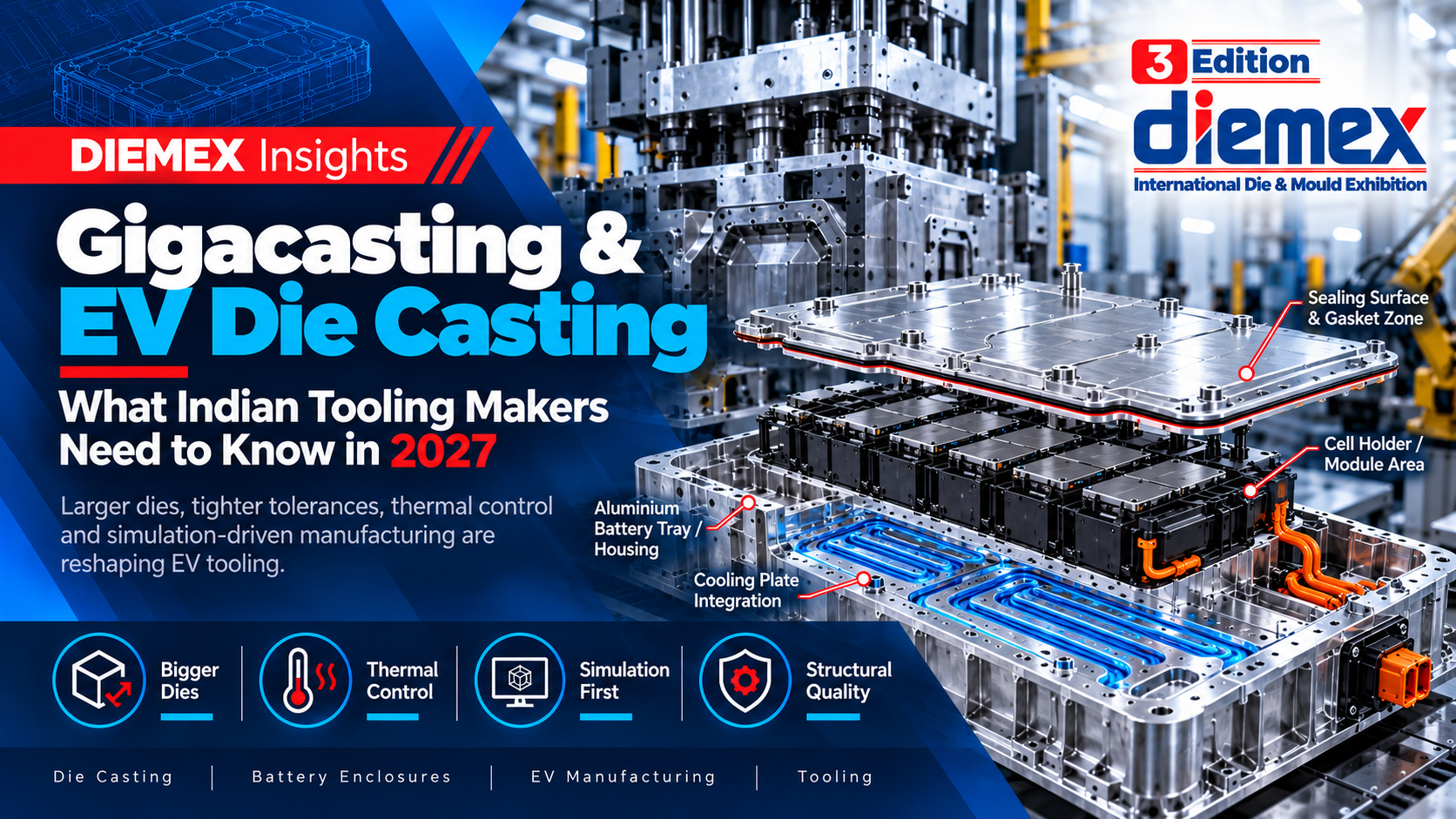
Gigacasting replaces dozens of stamped and welded parts with one large aluminium casting. For tooling makers, that changes die size, complexity, tolerances and lead times. Here’s what matters.
Gigacasting replaces dozens of stamped and welded parts with one large aluminium casting. For tooling makers, that changes die size, complexity, tolerances and lead times. Here’s what matters.
What is gigacasting?
Gigacasting (also called megacasting) uses very large high-pressure die casting machines, typically 6,000 to 9,000+ tonnes of clamping force, to cast big structural parts such as rear underbodies, front body sections and battery enclosures in a single shot.
Tesla popularised it, and many global OEMs and Chinese EV makers have since adopted or piloted it. The goal is fewer parts, fewer joints, a simpler assembly line and lower weight.
Why EVs are driving it
- Weight: Lighter bodies extend range and offset battery mass.
- Part consolidation: One casting can replace 70+ components, cutting robots, welding and logistics.
- Cost at scale: Higher upfront tooling cost, lower cost per vehicle at volume.
- Design freedom: Integrated ribs and mounting points are possible in one piece.
What it means for Indian tooling makers?
- Bigger, heavier dies. Gigacasting dies are among the largest in manufacturing. Tool rooms need large-format machining (big VMCs and gantry machines), heavy handling and large-capacity heat treatment.
- Thermal management is critical. At this size, uneven cooling means warpage, porosity and short die life. Expect more investment in conformal cooling design, thermal simulation and die-spray control.
- Simulation first. Flow and solidification simulation before cutting steel is now essential. A failed trial on a die this size is very expensive.
- Tighter quality expectations. Structural castings need low porosity, consistent mechanical properties and high dimensional stability. That puts pressure on die steel selection, surface treatments and in-process monitoring.
- Materials and alloys. Heat-treat-free structural aluminium alloys reduce post-cast distortion. Tooling partners who understand these alloys will have an edge.
- Maintenance and repair capability. Large dies need laser welding, refurbishment and spare insert strategies to avoid long downtime.
Opportunities in India
- Localisation: As EV platforms scale here, OEMs and Tier-1s will want local tooling to cut cost and lead time.
- Mid-size EV castings: Not every program needs a 9,000T cell. Motor housings, battery trays, and cross-members offer a practical entry point.
- Services: Simulation, die refurbishment, and trial support are growth areas beyond new-die manufacturing.
- Collaboration: Partnerships between Indian tool rooms and global machine and die suppliers can close capability gaps.
Challenges to plan for
- High capital investment in machines and infrastructure
- Skilled talent shortage in large-die design and trials
- Long qualification cycles with OEMs
- Competition from established Chinese, European and Japanese suppliers
Practical checklist for 2027
- Audit your machine capacity for large-die work.
- Invest in simulation and thermal design skills.
- Start with mid-size structural EV castings.
- Build relationships with die casting machine and alloy suppliers.
- Develop refurbishment and repair services.
- Track OEM sourcing plans and get on approved vendor lists early.
See it live at DIEMEX 2027
Die casting, tooling and mould technology will be on show at DIEMEX 2027, 24-26 March 2027, Auto Cluster Exhibition Centre, Chinchwad, Pune. It’s a chance to meet machine builders, die steel suppliers and EV component makers in one place.