Industry Insights
Battery Housing and Enclosure Manufacturing: Tooling Challenges
By DIEMEX Team ·
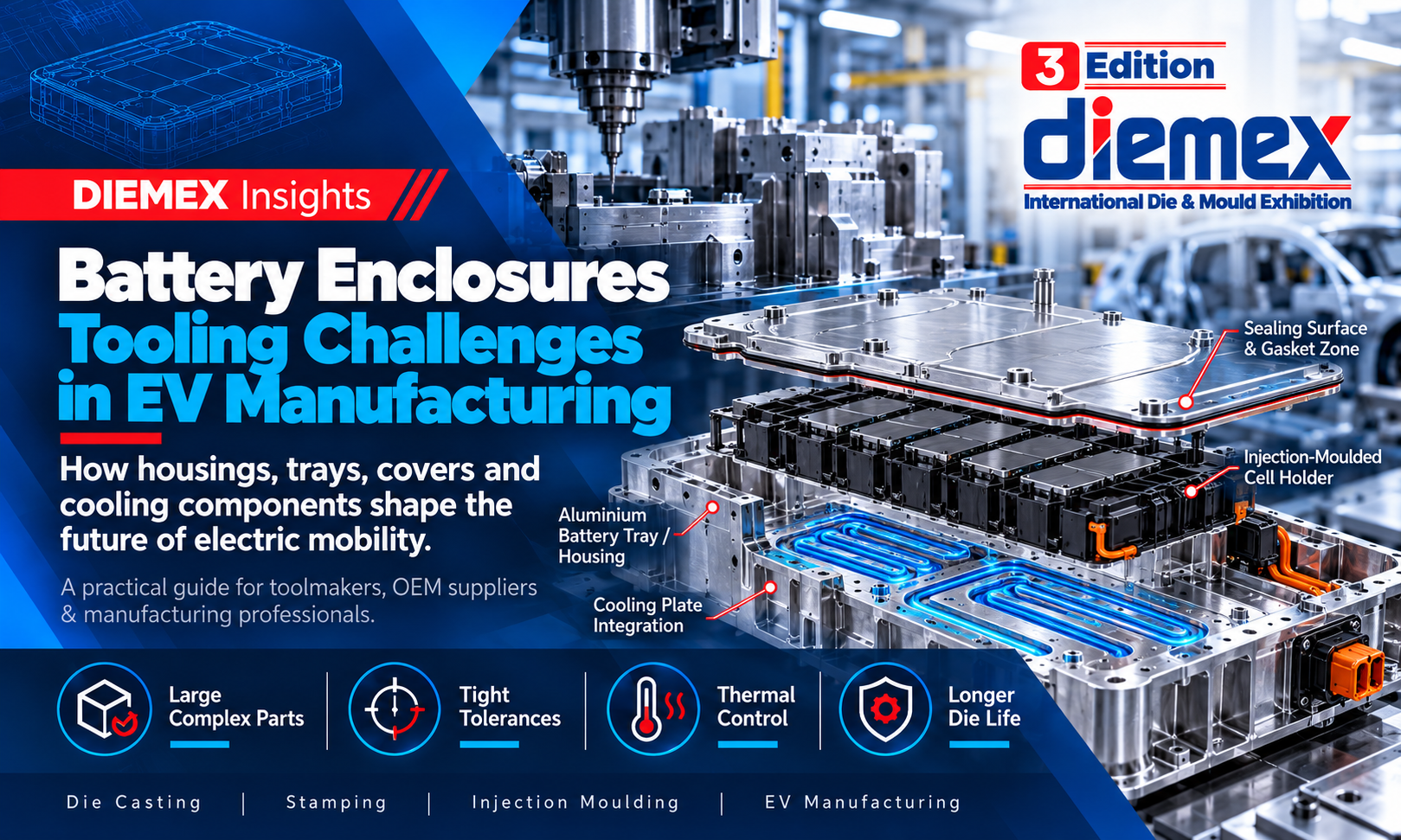
The main tooling challenges in EV battery housing and enclosure manufacturing, and how Indian die and mould makers can meet them.
DIEMEX Insights | International Die & Mould Exhibition, 3rd Edition
The battery pack is one of the most important and most demanding structures in an electric vehicle. Its housing must protect the cells from impact, heat, water and dust, carry structural loads, and stay as light as possible. Meeting all of this at production volumes puts heavy pressure on the tooling behind the housing.
This article looks at how battery housings and enclosures are made, the main tooling challenges, and what Indian die and mould makers should focus on to win this growing business.
What goes into a battery enclosure?
A battery pack enclosure is not a single part. It is usually a system of components, each made by a different process: • Pack housing and tray: often aluminium, made by die casting, extrusion or stamping, or fabricated from sheet. • Cover and lid: aluminium, steel or composite, typically stamped or compression moulded. • Cooling plates: aluminium plates with internal channels for thermal management. • Cell holders, spacers and brackets: commonly injection moulded plastics, with flame-retardant grades where required. • Seals and gaskets: for ingress protection against water and dust.
The material and process choice depends on the vehicle type, volume, cost target and safety requirements. Each route brings its own tooling demands.
Key tooling challenges
- Large, complex parts Battery trays and housings are big. Large die casting and stamping tools need rigid, heavy tool bases, high clamping forces and careful design to control distortion. Larger tools also mean longer machining time, higher material cost and more difficult trials.
- Tight tolerances and flatness Sealing surfaces, mounting points and cooling plate interfaces need tight dimensional control. Poor flatness can lead to leaks or assembly problems. Tool design, thermal balance and process stability all have to support repeatable accuracy.
- Thermal management in the die Large castings and moulded parts create uneven heat loads in the tool. Cooling design, including conformal cooling in critical zones, is important to reduce hot spots, shorten cycle times and limit heat checking.
- Die life and wear Aluminium die casting dies face thermal fatigue, erosion and soldering. Longer die life depends on the right tool steel, heat treatment, surface treatment and good maintenance planning, especially for high-volume programmes.
- Porosity and structural integrity Housings often need leak-tightness and consistent mechanical strength. Gating, venting, overflow design and vacuum-assisted or high-integrity casting methods help reduce porosity. Tooling has to be designed with these in mind from the start.
- Light weighting versus strength Thin walls and ribbed structures save weight but are harder to fill and harder to keep stable. Simulation of flow, solidification and distortion helps balance the trade-offs before steel is cut.
- Safety and material requirements Plastic components may need flame-retardant materials, which can affect flow, shrinkage and tool wear. Tool design has to account for the properties of the chosen grade.
- Short development timelines EV programmes move quickly. Tool makers are expected to deliver faster, with fewer trial iterations, which raises the importance of simulation, standardised mould bases and strong project management.
What tooling makers can do • Invest in simulation: use flow, thermal and distortion analysis to cut trial loops. • Build large-tool capability: machining capacity, handling, trial facilities and measurement for large tools. • Plan for die life: select proper steels, heat treatment and coatings, and set up maintenance schedules. • Strengthen quality control: CMM, 3D scanning and flatness checks on critical surfaces. • Standardise where possible: standard mould bases and components shorten lead times. • Build customer partnerships: engage with OEMs and tier suppliers early, at the design stage.
Opportunity for India
As EV manufacturing grows in India, demand for locally made battery components is expected to rise. Tool makers that build capability in large, precise and durable tooling will be well placed to supply housings, trays, covers and related parts to OEMs and tier suppliers.
See the solutions at DIEMEX 2027 Machine tools, tool steels, coatings, simulation software, measurement systems and mould-making technologies are all part of the answer. DIEMEX 2027, India's International Die & Mould Exhibition, brings suppliers and technology providers together under one roof.
• Dates: 24-26 March 2027 • Venue: Auto Cluster Exhibition Centre, Chinchwad, Pune • Organiser: Maxx Business Media Pvt. Ltd.
Register as a visitor: https://www.diemex.in/register?t=visitor
Key takeaways • Battery enclosures combine several parts and processes, each with its own tooling needs. • Size, tight tolerances, thermal control, die life and porosity are the main tooling challenges. • Simulation, large-tool capability and strong quality control help tool makers meet EV timelines. • Growing EV production in India creates opportunity for capable tooling suppliers. • DIEMEX 2027 is a place to compare technologies and meet suppliers.